
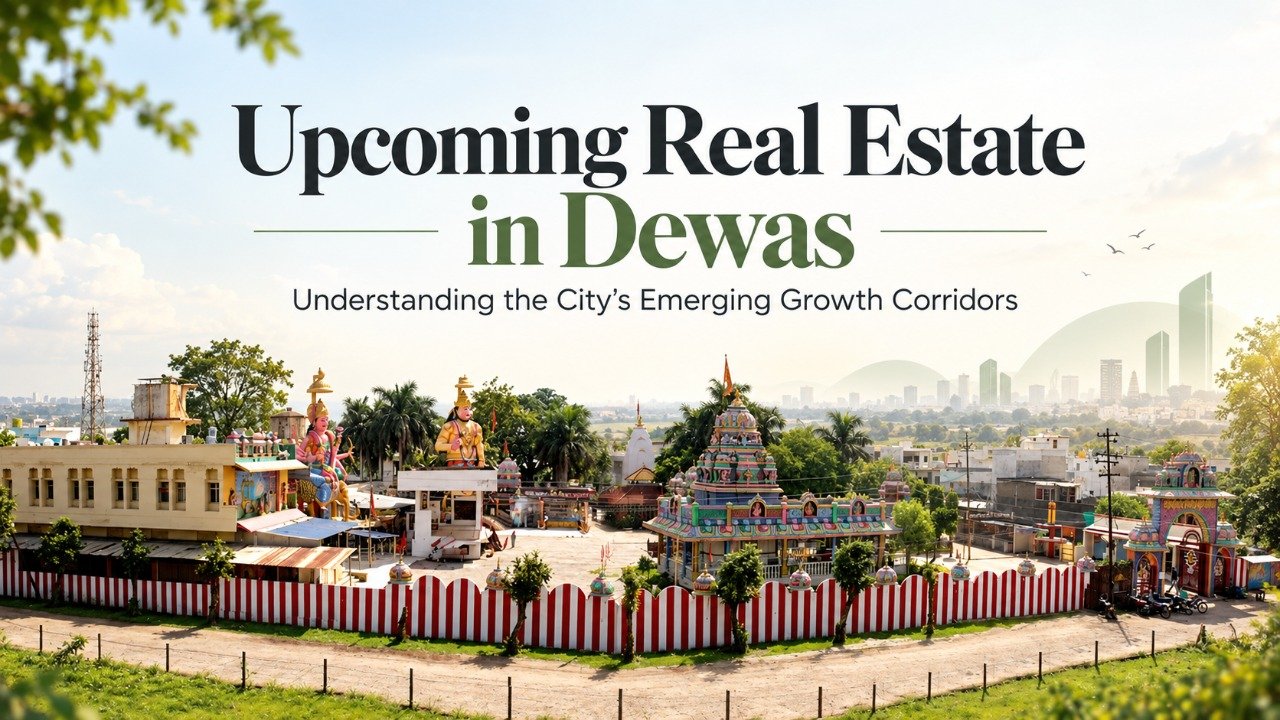
Upcoming Real Estate in Dewas: Emerging Areas & Growth Factors
How Infrastructure, Connectivity and Urban Expansion Could Shape Dewas’s Property Market
Dewas has traditionally been known as an important industrial city in Madhya Pradesh. Its location between Indore and Ujjain, established industrial activity, railway connectivity and road links have given it an economic role that extends beyond its immediate urban boundary.
Today, the conversation around Dewas property is becoming broader.
It is no longer only about buying a house, purchasing a plot or finding commercial space. Buyers are increasingly asking a more important question:
Why Dewas Could Become More Important in Madhya Pradesh's Real Estate Landscape
Dewas occupies a strategically connected position in western Madhya Pradesh.
According to the district administration, Dewas is connected by road with Indore, Ujjain, Sehore and Bhopal. The district also identifies Indore's airport as the nearest airport, approximately 40 km away, while Dewas has railway connectivity with several major cities.
This creates an interesting combination:
- Proximity to Indore
- Access to major road networks
- Railway connectivity
- Established industrial activity
- Regional employment opportunities
- Planned urban expansion
- Availability of land around existing development zones
For real estate, these factors matter because property demand is usually influenced by more than location alone.
A location becomes more attractive when people can reach it conveniently, work nearby, access services and connect with larger economic centres.
That is why infrastructure deserves serious attention when discussing the future of Dewas property.
1. Connectivity Could Remain One of Dewas's Biggest Real Estate Drivers
Connectivity is one of the first factors buyers should study when evaluating a developing property market.
Dewas is positioned on an important road and railway network and has relatively close access to Indore. The district administration describes Dewas as being approximately 35 km from Indore and 33 km from Ujjain by road.
The broader Indore Dewas region is also seeing infrastructure activity. For example, the Indore Development Authority has recently invited a tender for a proposed Rail Over Bridge along MR-12 between the Indore and Dewas railway stations.
Why does connectivity matter for property?
Better connectivity can influence:
- Daily commuting patterns
- Accessibility to employment centres
- Commercial activity
- Rental housing requirements
- Demand for residential development
- Logistics and industrial operations
- The attractiveness of peripheral development
However, better connectivity does not automatically mean that every property will appreciate.
The actual impact depends on the property's location, land-use classification, infrastructure execution, surrounding development, legal approvals and future demand.
2. Dewas's Industrial Base Can Influence Residential and Commercial Demand
Dewas has a long-established industrial identity.
The district administration maintains a dedicated District Trade & Industries Centre and describes industrialization and employment generation as important parts of the district's economic development framework.
This matters to real estate because industrial activity creates an ecosystem around employment.
When employment centres expand or become more efficient, demand can emerge for:
- Worker and employee housing
- Rental accommodation
- Retail shops
- Restaurants and daily-needs businesses
- Warehousing
- Offices
- Transport-related services
- Small commercial establishments
This doesn't mean industrial growth automatically increases property values. Instead, it creates potential demand channels that developers, consultants and buyers should examine alongside actual infrastructure and local market conditions.
For someone searching for a real estate consultant in Dewas, this is an important distinction.
A good property decision should consider not just today's surroundings but also why people may need to live, work or conduct business in that location in the future.
3. The Dewas Development Plan 2041 Is an Important Indicator of Future Urban Structure
One of the most significant developments for anyone studying Dewas's long-term property market is the Draft Dewas Development Plan 2041.
The Madhya Pradesh Directorate of Town & Country Planning lists the Dewas Development Plan 2041 as a draft plan and provides associated proposed land-use information.
4. Which Areas of Dewas Are Emerging as the Next Real Estate Growth Corridors?
Dewas has traditionally been known for its industrial base, but the city is also developing as a residential destination. As connectivity improves, new infrastructure comes in and residential communities expand, buyers are increasingly looking beyond established neighbourhoods and asking a more important question:
Where is Dewas developing next?
There is no single factor that can determine whether an area will become a strong residential location. A better way to assess an emerging market is to look at its connectivity, surrounding development, infrastructure, employment opportunities, planning framework and the kind of residential projects coming up there.
For someone exploring property in Dewas, understanding these factors can be more useful than simply looking for the cheapest plot or the newest project.
5. Why Is Dewas Attracting Increasing Real Estate Interest?
Dewas occupies an important position in Madhya Pradesh because of its relationship with Indore and its established industrial ecosystem.
The city's location provides road and rail connectivity to several important destinations, while its industrial activity creates an economic base around which residential and commercial development can grow.
The current property landscape also shows considerable activity in plotted development. One public market database currently records 167 real-estate projects in Dewas district, including 160 plotted developments, although such third-party databases should be treated as market references rather than official records.
This is important because residential growth doesn't always begin with large apartment towers. In developing urban areas, plotted communities can often become an important part of the transition from open land to organised residential neighbourhoods.
6. What Makes an Area an Upcoming Real Estate Location?
The phrase "upcoming area" is often used loosely in property marketing.
But how do you actually determine whether an area is developing?
A useful approach is to look at several indicators together.
1. Connectivity
Road connectivity is one of the first things buyers should investigate.
An area with convenient access to major roads can become more practical for:
- Daily commuting
- School and college travel
- Access to workplaces
- Shopping and healthcare
- Movement towards nearby cities
However, simply being close to a highway doesn't automatically make a location desirable.
The more important question is:
How easily can residents actually access the places they use regularly?
2. Existing Development
Look around the location rather than only at the project brochure.
Are there already:
- Houses being constructed?
- Established residential colonies?
- Shops and local businesses?
- Schools?
- Healthcare facilities?
- Roads and utilities?
- Other organised developments?
Existing activity can provide a clearer picture of how an area is evolving than a future-development claim alone.
3. Infrastructure
Infrastructure can determine whether land remains isolated or gradually becomes part of a functioning neighbourhood.
Buyers should examine:
- Internal roads
- Main-road access
- Drainage
- Water availability
- Electricity
- Street lighting
- Green spaces
- Public facilities
This is particularly important when comparing plotting projects.
A plot may look attractive on paper, but the surrounding infrastructure determines how practical the location will be for actual residential use.
7. Which Parts of Dewas Are Showing Residential Development Activity?
It is better to look at development corridors rather than declare one locality as the "best".
Current property listings show residential development activity along corridors including Ujjain Road, Indore Road, Mendki Road, Maksi–Bhopal Bypass, Indore–Bhopal Bypass, Bhopal Road and Balgarh Road. This indicates that residential development is spread across multiple parts of Dewas rather than being concentrated in one single location.
8. How Does Industrial Growth Influence Residential Development in Dewas?
Industrial development and residential development are often connected.
When an industrial area expands, it can create demand for housing from:
- Employees
- Business owners
- Service providers
- Professionals
- Supporting businesses
- Families moving into the city
But there is an important distinction.
Industrial growth alone does not guarantee residential property appreciation.
For an industrial corridor to translate into sustainable residential demand, people need reasons to live nearby. That means housing, roads, schools, healthcare, shopping and everyday services also need to develop.
This is why buyers should consider the complete ecosystem, rather than looking at a single infrastructure announcement.
9. Why Connectivity With Indore Matters for Dewas Real Estate
The relationship between Dewas and Indore is an important consideration when evaluating the city's residential growth.
People may choose to live in one city while working, studying or conducting business in another. As a result, travel time and road connectivity can influence residential preferences.
For a property buyer, this creates a practical evaluation point:
How does the location perform for your actual daily commute?
A location that looks attractive on a map may not necessarily be convenient during peak travel hours.
Therefore, a site visit should ideally include:
- Checking the route during normal traffic
- Understanding access to major roads
- Checking nearby public transport
- Measuring practical travel time
- Looking at road conditions
10. What Role Do Planned Residential Communities Play?
There is a major difference between purchasing an isolated piece of land and buying within a planned residential development.
In a planned development, buyers may be able to evaluate elements such as:
- Road layout
- Plot demarcation
- Open spaces
- Drainage planning
- Utility infrastructure
- Access roads
- Community planning
- Applicable approvals
This is one reason organised plotting projects are becoming an important part of the residential-development conversation in growing cities.
11. How Should You Evaluate RERA Approved Projects in Dewas?
RERA registration is an important part of a buyer's due diligence, but it should not be treated as the only factor.
When considering RERA approved projects, buyers should examine the project's registration details and applicable documentation through the relevant official channels.
They should also understand:
- Who the promoter is
- What the approved project covers
- Project location
- Development status
- Promised infrastructure
- Applicable completion timelines
- Documentation relating to the property
RERA information should be verified independently rather than relying only on marketing material.
12. Where Does DMG Estate Fit Into Dewas's Residential Development Landscape?
One of the established names operating in Dewas's property market is DMG Estate.
According to the company's current website, its portfolio includes residential, commercial and plotted developments in locations such as A.B. Road, Tonkkala, Prestige College Road, Bilawali/Maksi Road and Kshipra.
The company describes itself as a real estate developer and property consultant focused on residential and commercial development in Dewas. Its website also highlights transparency, infrastructure planning and long-term development as part of its approach.
For someone researching residential property developers, DMG Estate can therefore be included as one of the local developers worth researching alongside the project's location, documentation, development status and infrastructure.
What Residential Options Can Buyers Explore With DMG Estate?
DMG Estate's current project portfolio includes developments such as:
- DMG Sai Dham City — A.B. Road, Tonkkala, Dewas
- Garg Estate — near Prestige College, A.B. Road
- DMG Bhakti Avenue — Bilawali, Maksi Road
- DMG City Kshipra — Sukhliya, Kshipra, Dewas
These projects represent different locations and development formats, which is why buyers should evaluate them based on their individual requirements rather than assuming that one location works for everyone.
13. Is Buying a Plot in an Emerging Area Better Than Buying a Ready Property?
There isn't a universal answer.
The right option depends on why you're purchasing.
A plot may suit someone who wants:
- Flexibility in future construction
- Greater control over home design
- A long-term landholding
- A residential plot within a planned development
A ready or constructed property may suit someone who wants:
- Immediate occupancy
- A finished structure
- Less involvement in construction
- A clearer understanding of the finished property
This is why people searching for plots for sale in Dewas should first decide whether they are buying for immediate residential use, future construction or long-term ownership.
14. What Should You Check During a Site Visit?
A site visit should go beyond simply looking at the plot.
- Check the approach road: Don't just check the distance from the main road. See how easily you can actually reach the project.
- Look at surrounding development: Are nearby properties occupied? Are homes being constructed? Are commercial activities appearing?
- Check infrastructure: Look at roads, drainage, electricity and water arrangements.
- Visit at different times: A location can feel completely different during morning, afternoon and evening hours.
- Speak to people nearby: Local residents and nearby businesses can sometimes provide practical information that isn't visible in a brochure.
- Verify documentation: Do not make a purchase decision based solely on verbal claims.
15. What Could Drive Dewas Property Demand Over the Next Few Years?
Instead of looking at one single factor, it is better to consider several demand drivers together.
| Growth Driver | Potential Real Estate Relevance |
|---|---|
| Road connectivity | Improves accessibility |
| Railway connectivity | Supports regional movement |
| Industrial activity | Creates employment-linked demand |
| Urban planning | Guides future land use |
| Residential expansion | Creates housing demand |
| Commercial development | Supports local business activity |
| Logistics infrastructure | Supports industrial and commercial ecosystems |
| Proximity to Indore | Connects Dewas with a larger economic centre |
| Public infrastructure | Improves liveability |
| Planned development | Can create more organized urban growth |
These factors should be treated as market indicators rather than guarantees of property appreciation.
16. A Simple Way to Evaluate Dewas's Future Growth
A buyer can use a five-part framework before selecting a property.
The 5-Point Dewas Property Check:
- Location: Is the property positioned near existing or planned activity?
- Connectivity: How easily can residents or businesses reach major roads, railway stations and employment centres?
- Development: What infrastructure and surrounding development already exist?
- Documentation: Are ownership, approvals and land-use details clear?
- Demand: Who is likely to use or occupy the property?
This approach is much more practical than choosing property based purely on promotional claims.
What Should Buyers Look for When Choosing a Property in Dewas?
Future growth is useful only when it translates into a property that makes practical sense.
Before purchasing, buyers should consider:
- Existing infrastructure: A property should not depend entirely on future promises.
- Planned infrastructure: Check official government sources to distinguish between proposed, approved, tendered and completed projects.
- Land use: Verify whether the property's designated use matches the intended purchase.
- Developer credibility: Check previous projects, documentation, approvals, construction quality and delivery record.
- Legal documentation: Title, ownership, approvals, encumbrances and registration should be examined before making a commitment.
- Access and utilities: Road access, water, electricity, drainage and other basic services can strongly affect practical usability.
- Surrounding development: Look beyond the project's boundary. Nearby schools, healthcare, retail, employment and transport infrastructure can influence liveability.
How a Real Estate Developer in Dewas Can Add Value
A developer's role extends beyond dividing land or constructing buildings.
A well-planned development should consider:
- Site selection
- Land-use compatibility
- Internal roads
- Drainage
- Utilities
- Open spaces
- Accessibility
- Construction standards
- Documentation
- Long-term neighbourhood usability
For buyers, this means evaluating the development as a complete ecosystem rather than focusing only on plot size or building elevation.
How a Real Estate Consultant in Dewas Can Help Buyers
Property decisions often involve several variables that are difficult to compare independently.
A consultant can help buyers understand location differences, residential versus commercial options, plot versus constructed property, current versus emerging areas, connectivity, documentation requirements, budget suitability, rental considerations, development potential, and exit considerations.
The value of professional advice is particularly relevant when a buyer is comparing multiple locations with different infrastructure timelines.
Why Dewas's Future Should Be Viewed as a Regional Story
One of the biggest mistakes in analysing a developing property market is looking only at city boundaries.
Dewas's relationship with Indore, Ujjain and the wider industrial ecosystem is important.
The district administration highlights Dewas's road and railway connections, while state-level planning and logistics documents show the wider importance of industrial and freight connectivity across Madhya Pradesh.
At the same time, the Draft Dewas Development Plan 2041 provides a formal planning framework for residential, commercial, industrial, transportation and other land uses.
Together, these factors suggest that the city's future should be evaluated through three connected lenses:
Urban growth + Economic activity + Connectivity
That combination is more useful than simply asking whether property prices will rise.
What Does the Future Hold for Dewas Real Estate?
Dewas's property market is entering an interesting phase where infrastructure, industrial activity, connectivity and urban planning are increasingly interconnected.
The Draft Development Plan 2041 provides a long-term planning framework, while Dewas's existing road and railway connections support its relationship with surrounding economic centres.
The future, however, should not be viewed through a single "growth" narrative.
Different areas can develop at different speeds.
Some locations may benefit from improved connectivity. Others may remain primarily agricultural or low-density depending on land-use planning. Some commercial areas may attract businesses while other projects may take longer to establish a strong catchment.
For buyers, the smarter approach is therefore to combine location research, infrastructure verification, planning information, legal due diligence and actual market demand.
For DMG Estate, this is the approach we believe makes property conversations more useful: helping buyers understand not just what a property looks like today, but also the factors that can influence how a location develops over time.
Frequently Asked Questions
1. Which is the most upcoming real estate area in Dewas?
Dewas does not have one universally established "most upcoming" area. Residential development is occurring across multiple corridors, including areas connected with Ujjain Road, Indore Road, Maksi Road, Bhopal Road and other developing routes. The right location depends on connectivity, infrastructure, surrounding development and the buyer's requirements.
2. Why is Dewas becoming an important residential property market?
Dewas benefits from its industrial base, connectivity with nearby cities and ongoing residential development. These factors can support housing demand, particularly when infrastructure and local amenities develop alongside new communities.
3. How can I identify a good location for plots for sale in Dewas?
Start by checking road connectivity, surrounding development, drainage, electricity, water availability, land-use information, applicable approvals and the developer's documentation. A physical site visit is also important because the actual surroundings can be very different from what appears in an online listing.
4. What should I check before buying in RERA approved projects?
Verify the project's registration details through the relevant official RERA records and review the promoter information, project details, applicable approvals, development status and promised facilities. RERA registration should be one part of your due diligence rather than the only criterion.
5. How can I compare residential property developers in Dewas?
Compare developers based on their documented project history, transparency of information, development quality, project execution, applicable registrations and the condition of completed projects. Buyers should also evaluate the specific project rather than judging a developer only by its brand name.